Enforced quality
AICode includes a built-in quality assurance harness that works out of the box on any codebase: sound architecture, no silent regressions, remembered constraints, reviewable patches, and tests that actually catch broken code.
What uncontrolled AI agents produce
What AICode enforces instead
Junior-grade architecture that accumulates technical debt from day one
Narrow-focus changes that break invariants and will end in debug hells
Structured specification reviewed and approved by you before a single line is written
Silent regressions that look like the real thing, caught too late
Refine + Verify loops that audit the spec and the generated code for design flaws
No project memory: the AI forgets your constraints on every new prompt
Project map: the model understands global architecture, with far fewer hallucinations
Auto-edits written directly to disk before you can review them
Reviewable patches in a virtual workspace. You accept changes file by file, line by line
MCP authorization gates by tool
Unit tests that validate and hide broken code
Hallucinations dressed as confidence
Honest by design: the model won't bluff when context is missing. It will ask
The anti-"wow" effect
True developer story: A top-tier AI coding agent generated the messaging bus for a production application in thirty minutes. Impressive. The bus was optimized with eight message categories, varying by argument count, whether a response was required, async or sync execution. It was a nice PR, with green unit tests, ready to merge. The kind of work that makes you say "Wow".
One month later, after connecting several services on top of this architecture, I understood the bus was unmaintainable. Every new integration required considering all eight variants. When confronted on the design, the model defended it: "You save 2-3 instructions here, 1 CPU cycle there". Meanwhile, the entire project was sinking under the weight of its own complexity.
It took three weeks of refactoring to enforce a single format: one single RPC contract, one single message type. The model pushed back: "You're wasting resources, it'll be slow". In reality, 1ms of overhead at runtime is invisible in production. What the model couldn't measure, and therefore ignored, is that the scarcest resource isn't CPU; it's human capacity to understand and maintain code.
AICode was built from that lesson. The Specify and Refine stages exist to intercept exactly this kind of decision before it gets coded, connected, and propagated across the entire architecture. Uncontrolled generative AI is a disease. AICode is the antidote.
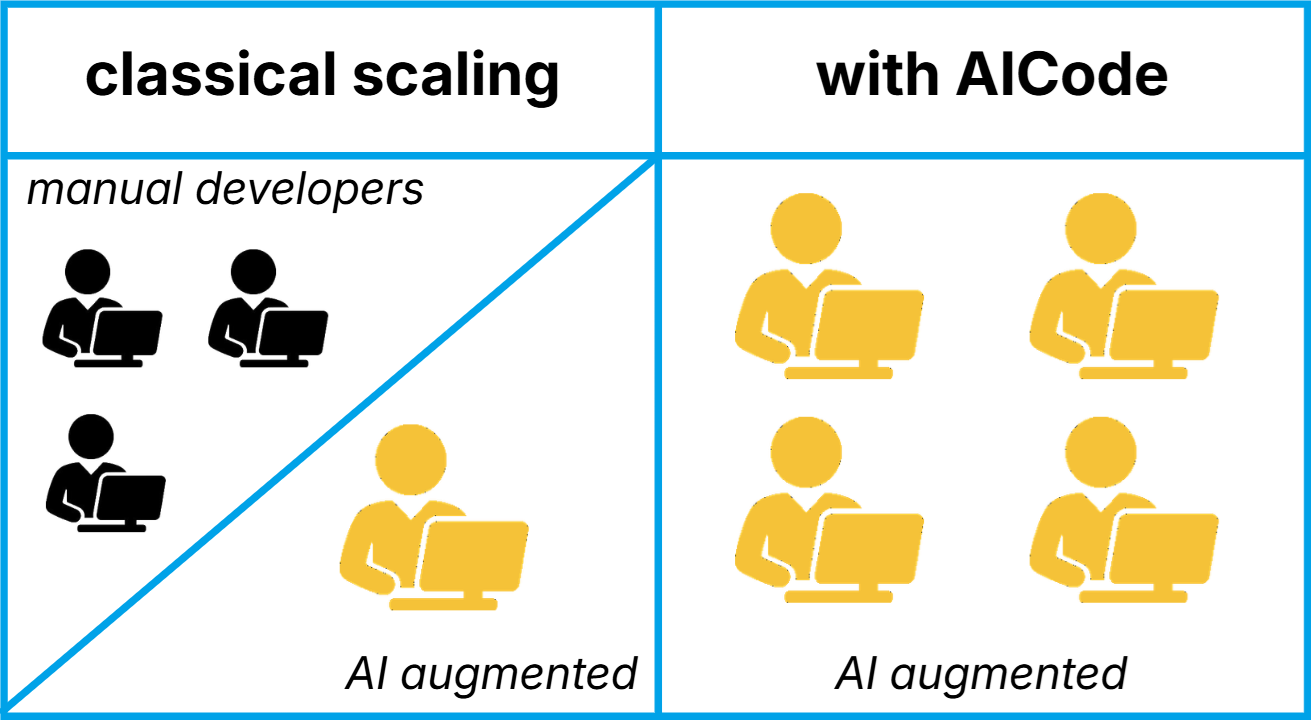
Quality is what lets you scale.
AICode turns rare expert-level prompt engineering knowledge into a software commodity, making it easy to scale teams.
Unlike standard AI tools that represent a major risk of code pollution, AICode's specialized workflow allows AI acceleration to be safely deployed across entire groups.